Showing posts with label turkish. Show all posts

Monday, August 2, 2010

Karadeniz Romano Beans

One of the best ways to satiate an appetite after several hours of climbing Istanbul’s steep hills is to step into a lokanta. At these cozy, informal restaurants, similar to traiteurs in France, the establishment’s offerings are all laid out behind the counter, which is great for the traveler who is less familiar with the names and contents of Turkish dishes than she’d like to be. You can point to and inquire about the various stews, pilafs, and salads and know much more about what you eventually request to have heaped on your plate than you would if you had ordered blindly from a menu.

The food at lokantas is usually simple and traditional, the kind of thing that benefits from being prepared ahead. But when the simplest food is prepared with good ingredients and small, painstakingly made batches, it can impress just as much as a fancy restaurant.

One lunch I had at a lokanta specializing in Karadeniz cuisine (from regions along the coast of the Black Sea) was particularly memorable. I had ordered a stewed romano bean dish that looked hearty and satisfying, but I discovered after one bite that it had much more to recommend it than its nutritional value. There was some subtle ingeniousness to its flavor, soft yet slightly tangy, the herbs and spices blending into a single coherent background, making it difficult to identify and single component.

When I saw some romano beans at the Beehive Farmer’s Market down the street from my new apartment, I decided to try to recreate the dish, even though I knew it would require a lot of experimentation to get elusive the seasoning right. My first attempt included rosemary, garlic, and onion for aromatics, and a splash of balsamic vinegar for some depth and a balance to the sweetness of the tomatoes. It was good, but nowhere near revelatory. I left most of my spice collection in New York, and cooking with the more limited supplies I’ve gathered here is like switching from a grand piano to a 49-key Casio keyboard. But I believed I could still do better, and the next day I reheated it with some fresh sage, more fresh rosemary, ground sumac, and dried thyme.

Day two’s version was better, and in fact very good. A slice of Acme’s herb slab stood in place of the shopping bag of fresh, fluffy foccacia that came with each table at the original Karadeniz lokanta. Below is the recipe for an approximation of the final version, but if you’re on your way to Istanbul, let me know and I’ll have Katherine take you to get the real thing.

Note: Even more than expected, this is definitely a dish that improves as it sits in the fridge. The last helping, consumed on day three, was by far the best, and a rival to what I had in Istanbul.

Karadeniz Romano Beans

Slightly less than 1 lb romano beans (I happened to have grabbed 4/5 lb)
1 8 oz. can diced tomatoes
2 tbsp balsamic vinegar
Half a medium yellow onion, diced
1 clove garlic, minced
6 inch rosemary sprig, chopped
2 large sage leaves, chopped
½ teaspoon sumac
½ cup water
Salt and pepper, to taste

Trim ends of romano beans and cut into halves or thirds, depending on size. In a deep saucepan or Dutch oven (one of which I am now the proud owner, or at least borrower!), saute onion in olive oil for a few minutes until softened and slightly browned. Add salt and pepper, rosemary, garlic, sage, and sumac, cook a minute more. Deglaze with balsamic vinegar, then add tomatoes and bring to a boil. Add beans and water (add more water if the mixture doesn’t cover the beans, then reduce to a simmer and cover. Cook for 50 minutes, until beans are very tender. Let cool in the pot for 15 minutes or so, allowing the stew to thicken.

Thursday, July 29, 2010

A Call for Cream

Food and travel both tend to lead to cultural analysis, and I have a question to pose to my homeland now that I’m back: What’s with the lack of proper appreciation for cream?

There is a paucity of knowledge in this country of the various textures, viscosities, and acidities that cream can take on when its fat content and temperature are allowed to roam freely. I blame a combination of the ready availability of Reddi-wip (that’s right, I googled the spelling), an aversion to the idea of fat, and a fanatical fear of bacteria. If you couldn’t get whipped cream in a can, maybe laziness would lead to the discovery that those strawberries will taste great swimming in a pool of liquid cream. Better yet, double cream. But I have a horrible feeling that people around here don’t really know what double cream is.

Squeamishness about pasteurization and fear of fat form the biggest obstacle, the latter inhibiting motivation to try new creamy things, and the former providing an excuse not to. Clotted cream, the ultimate does of milk fat, is very difficult to find in America, and also impossible to make at home, since it has to be made from unpasteurized milk. The milk is heated just below boiling and then left to sit, allowing the cream content to rise to the top. The resulting silky substance is skimmed off for spreading on scones and cakes. They make a similar product in Turkey, called kaymak, which is served in a pool of honey and eaten with toast. Not something you need to have heaps of at every meal, but certainly part of a complete breakfast or special teatime snack.

Then there’s fromage frais and crème fraiche. Crème fraiche is starting to show up more here (Trader Joe’s makes it), and it’s essentially the same thing as sour cream, though I think it has a better texture (maybe it has fewer unpronounceable viscosifying chemicals in it). But fromage frais remains elusive, which is a shame, because it’s a perfect tangy accompaniment to stewed fruits, tarts, or fresh berries. Greek yogurt or softened cream cheese would probably work in many of the same contexts, but there’s still something specific about fromage frais.

Maybe there are completely acceptable substitutes for all of these creamy concoctions, but with a centuries-old tradition of dairy science experimentation, why limit ourselves?


To cleanse the palate, I’ll end with some photos of the impressive produce at the Fatih Mosque street market.


Friday, July 23, 2010

Bar Snacks

New York may have the ultimate bar culture, but other cities certainly outdo it in the bar snack category. Of course, I’m always grateful for a bowl of free pretzels or peanuts, and I should stress that when I say “bar snacks” I mean the free stuff – not the “bar food” that you pay for. New York is teeming with places that offer delectable grass-fed beef sliders, house-made cornichons, and all kinds of artisanal cheese plates, usually for a price that seems unfairly proportioned to their size. But for someone who’s interested in something to bridge the gap between another round and dinner, New York’s bars could take a cue from Balkon in Istanbul.

Balkon is a charming bar in the Tünel area off the main pedestrian street, Istiklar. A tiny elevator on the ground floor takes patrons up to a shady, shabby chic bar and seating area, and another flight of stairs leads to the blindingly reflective rooftop area with a recessed bar and a stunning view of the entire city.
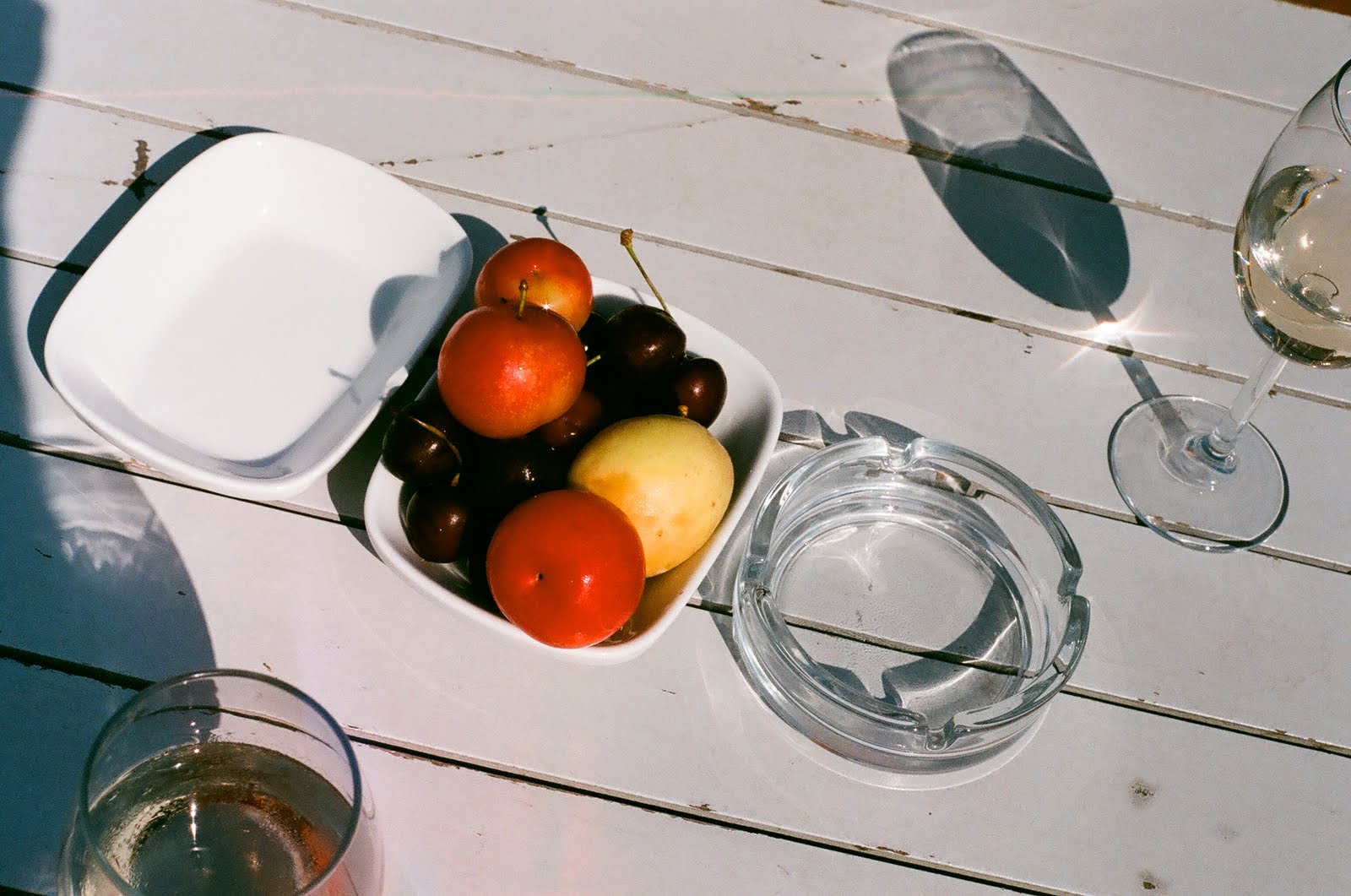
The small plate that arrived with our menus stunned me almost as much as the landscape. I expected the usual, something as old as the bar itself but chock full of preservatives to ensure that it looked the same as it did on day one, but instead, they handed us a plate of fresh plums and cherries! Nothing could go better with a blazing sun and gleaming city than a glass of white wine and some fresh Turkish produce. I’m glad the people of Balkon figured that out.

It seems like the brilliance of fruity summer bar snacks exists in San Francisco as well. My sister recently told me about a venue in Noe Valley whose backyard is filled with overgrown blackberry bushes. For the next few months, that means unlimited bar snacking for everyone.

Monday, July 19, 2010

Mulberries

American summers are full of berries: strawberries in shortcakes, blueberries in pies, raspberries in tartlets. But now that I’m back in the States, I’m finding it impossible to track down an incredible berry that I saw on almost every corner in Istanbul: the mulberry.

Mulberries aren’t entirely unknown in this country, but they’re probably a C-list ingredient recognized mostly from their roles in “Pop Goes the Weasel” and specialty store jams. I don’t think I had much of an idea of what a fresh mulberry looked like until I saw them in Turkey, and was extremely surprised to find out that they come in white. Though there are darker varieties, the white ones were common in Istanbul, and have a delightfully maggoty look. Their taste was very mild, similar to figs, and I’m sure their delicate softness makes them very difficult to transport. Which is unfortunate, because I would like very much to buy some white mulberries and convince my German roommates that maggots are used all the time in American cuisine.

It just goes to show you that you shouldn’t pass up food in unfamiliar colors, or you might miss out on some tasty experiences. I was skeptical that the bright green figs I bought could be in any way ripe, but it turned out that they contained delicious ruby insides, and were very refreshing after hiking to a beach on one of the Princes’ Islands.

Though the summer fruit here in the Bay Area leaves nothing to be desired, I still slightly miss the novelty of Istanbul’s produce, and the fun of asking for it in Turkish. Mulberry is “dut,” and you never get to say anything as amusing in an American market.

Friday, July 9, 2010

Istanbul's Surprise

I just got back from Istanbul, where I spent six days trying to sample all the food I’d heard about and had to try, plus all the food I’d never heard of before, plus all the food I knew and loved and had to try at its point of origin. Of course, in only six days, I came nowhere close to succeeding. I’m going to have to go back.

I don’t have any photos at this point, because I’ve been taking pictures on actual film (yes, you can still buy it at a few select locations) that will have to be developed when I get back to America. I’m going to hold off on posting about the more visually impressive food-related experiences until then: the market near the Fatih mosque that seemed to go on forever, the glitz of the Spice Bazaar, the strange albino blackberries that turned out to be mulberries, the fresh fruit that served as bar snacks with at a rooftop bar with a view spanning two continents – all of these would benefit from photographic proof. So for now I’ll talk about one of the things that surprised me most about Istanbul: the bread.

My first night in the city, we went out for meze, or “Turkish tapas,” as it was explained to me. Being intimately familiar with every menu of Lebanese maza in the 11201 zip code, I expected to be able to predict everything that would arrive at our table. We chose a few items (aubergine puree, sardines, hummus, cucumber yogurt) and I asked Katherine if she thought that would be enough – they were going to bring us unlimited pita anyway, right? Wrong. At least, not quite, she said. In Istanbul, they eat meze with slices of white bread. There is pide, but it’s mostly used as a base for boat-shaped pizza-like things topped with roasted vegetables or ground meat, or for döner wraps. I didn’t fully believe it until the bread basket got to the table, but it’s true: Istanbul, to my surprise, is teeming with leavened bread.

This meal opened my eyes to the fact that Turkish food, at least in Istanbul, has significant Balkan and Eastern European influences in addition to its Middle Eastern ones. A few days later, I had lunch at a lokanta specializing in Black Sea cuisine, which served flavorful fava beans stewed in the pod, and also provided each table with a gargantuan plastic bag of fluffy, foccacia-ish bread. I quickly discovered that bakeries and street carts sell sesame rolls in a variety of shapes (including the ubiquitous simit, a large circular twist), along with fairly decent brioche, and we even found some delicious challah at a particularly nice place in Kurtulus.

Not long ago I was buying a bag of pitas every two or three days. I expected a trip to Turkey to increase that average, but I haven’t had a single one since I left America. But with a simit vendor on every street corner, I didn’t have a chance to miss them.

Wednesday, June 3, 2009

All the Way to Chicago for Turkish Ice Cream


Last weekend was my third time visiting Chicago, but my first visit during a time of year when the exterior environment was hospitable to human life. Fortunately for me, it also coincided with the annual Turkish Festival in Daley Plaza.

Of all the outings that Katherine and I planned before my visit, this was probably the one I insisted on the most, even though in some ways it was hardly a break from what I’ve been doing in New York. Chase moved to Atlantic Avenue in March, and a Middle Eastern restaurant of some sort seems to occupy almost every fourth storefront on his stretch of the avenue. As a result I’ve discovered a new favorite food in the “Crazy Fatoosh” sandwich available at Fatoosh (a huge, fluffy pita wrapped around four salads of your choice), I’ve spent so much time wandering the aisles at Sahadi’s that I think they’re going to start asking questions soon, and I’ve probably consumed about three tons of hummus.

So the Turkish Festival in Chicago offered a lot of familiar (and beloved) items: grilled kebabs, hummus drizzled with olive oil and sprinkled with paprika, herbed eggplant salad, and flaky spinach pie. But it also had something I’d never tried, something that turned out to be nothing quite like anything I’d ever tried before: Turkish ice cream, or dondurma.

The sign in front of the ice cream stand claimed that the crucial ingredient in dondurma is orchid, so I expected it to have a floral, soapy taste like the lavender ice cream I loved to get in Paris. But, I eventually discovered, orchid does not contribute to the taste of the ice cream: in fact, powdered orchid root (or salep) is used to give the final product a distinctive chewy texture. Yes, chewy.

At the festival, tubs of dondurma were loaded into a cylindrical container and then pummeled into submission by a man with a sharp stick, presumably to soften it slightly. Once he deemed it ready to serve, he used the stick to extract a rectangular slab of the stuff (this ice cream is not conducive to scooping), which he stuck vertically in a waffle cone, and dipped in crushed pistachios. The consistency reminded me of one of those trademarked goops that were all the rage when I was about eight – was “Gak” the one that stretches into long strings when you pull it slowly, but breaks clean if you pull it apart fast? Turkish ice cream is pretty much the same idea. But instead of smelling like chemicals and presumably tasting similarly, it has a mild and creamy vanilla flavor, delicately sweetened and light enough for you to want to eat a whole lot of it.

Unfortunately, it seems that dondurma is very difficult to find in the United States, because of the rarity and high cost of the salep powder that creates its essential characteristics. Internet searches have turned up recipes that substitute cornstarch, which, for those of you with ice cream makers, might be easier than a trip to Turkey. But I’m determined to find some of the real thing somewhere in this city, not only to satisfy my own addiction, but to introduce dondurma to everyone I know: the texture is something truly foreign to most American tongues, and certainly worth experiencing.